History faculty often look to current events for inspiration when developing new courses because, as UW history professor Charity Urbanski states, "The past is never really past." This year, the department of history offered three new undergraduate courses that are all quite relevant to our current timeline: Gender and Sexuality in Medieval Europe, taught by Urbanski, Seattle Labor History with Andrew Hedden, and Modern Olympic Games by Kyle Haddad-Fonda.
Through recent conversations with each of these faculty, we learned about the joys of teaching, the challenges of choosing the right sources, as well as how their courses relate to the current political moment.
Charity Urbanski
Professor Charity Urbanski has taught the course Women in Medieval Europe for nearly a decade now, but lately she felt the urge to offer a complementary course that incorporates recent research into Medieval history focused around the construction of masculinity, queer and trans history, and intersex bodies. The idea came to her while researching her book Medieval Monstrosity (Routledge, 2023). "I’m particularly interested in the way that the rhetoric of monstrosity was deployed to enforce normative ideas about gender and sexuality, and to demonize and authorize violence against anyone who departed from those norms."
Urbanski created the class with the help of a former student of hers, who was pursuing a master's in teaching. Together, they faced the challenge of constructing a syllabus that would span the thousand year period of the Middle Ages. While it would have been much easier for Urbanski to have a more narrow chronological focus, she decided to cover the whole period because it was essential for her to convey to her students just how much norms around sexuality and policies changed during that time. "In the early Middle Ages, there was no authority that had the means to police gender or sexuality in any systematic way, but by the end of the period there was a sophisticated regime of repression in place in western Europe that carried into the Early Modern era and helped establish many of the attitudes and prejudices that are still with us today."
Urbanski enjoyed seeing how enthusiastically her students, mainly history majors but also students from gender, women’s, and sexuality studies, engaged with the primary sources. "I heard from a lot of students that they identified with the people we were reading about in a way that they hadn’t expected, and that was incredibly gratifying because that had been my plan all along."
Asked to reflect on how current events influenced her decision to create this class, Urbanski tells us that she really wanted to explore with students how and why Western society became more interested in policing gender norms and sexual behavior during the Middle Ages. "One of the main reasons I became a historian was because I wanted to understand where things like sexism, racism, and homophobia had come from and why they were so prevalent in the culture I grew up in. It turns out that they all have premodern roots and that the Middle Ages was a particularly formative period for all of them."

Nun collecting penises from a tree, Roman de la Rose de Richard and Jeanne de Montbaston, French, 14th century, BnF, Français, 25526.
Andrew Hedden
Originally from Seattle, Andrew Hedden devoted his dissertation to the economic transformations of his hometown during the 1970s and the effects it had on the working class—to be able to teach a course on Seattle's labor history has long been a dream of his. As a teenager in the 1990s, he had already sensed the disconnect happening between the global fame of Seattle as the home of grunge music, Starbucks, and Microsoft and the real history of its working class. "It’s the history behind the headlines—the steep race and gender divides within the American working class, the rise and fall of organized labor, and the restructuring of global capitalism and the U.S. empire—that truly distinguishes Seattle as an important site to study labor history."
When asked what sources his students are reading, Hedden explained that while there is ample literature on the 1919 Seattle General Strike, less emphasis has been placed on the connections between race and gender in the city's economy prior to World War II. There is also no comprehensive work on the years after that war, which left Hedden sourcing book chapters and essays about Seattle's labor history from the 1930s onwards. "My favorite of these readings is probably a chapter on race and gender at Boeing during World War II by Polly Reed Myers, which documents how the company went out of its way to keep women and Black workers peripheral to airplane production despite the company’s overwhelming need for their labor." During the week in which the decade of the 1980s is discussed, Hedden has his students watch a powerful documentary called Streetwise, which looks at the lives of teenagers living on the streets of downtown Seattle. "It is a heart-wrenching portrayal of how young people and their families struggled to navigate the turbulence of the city’s transition from a blue collar to a white collar economy."
When asked whether he sees parallels between Seattle's labor history and the current attacks on America's immigrant labor force, he stated, "The parallels between Seattle’s past—full of racist pogroms, violence against migrant workers, and demagogic politicians—and the present are painful and easy to draw." However, he also emphasized that he wants his students to leave his course with a recognition of the strength the working class has as historical agents. "If there is a lesson that I believe my students should take away from my class, it is that working people are powerful, and when they act collectively, they make history."
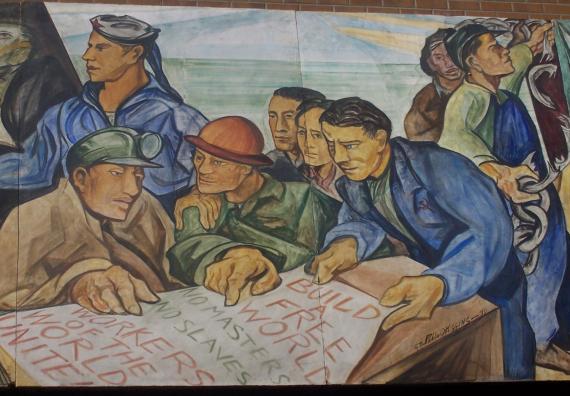
Selection of the Union Mural in Kane Hall by Pablo O'Higgins
Kyle Haddad-Fonda
When Kyle Haddad-Fonda was a boy, he drew the flags of all the countries competing at the 1994 Winter Olympics in Lillehammer, Norway. No one could have guessed that this fascination would one day lead to the development of an entire history course based around the modern Olympic Games. While teaching his class about the Cold War, Haddad-Fonda took notice that references made to sporting events really captured the attention of his students. One student in particular, Moniva Pal, was so captivated by his sharing of the Catholic Church's promotion of soccer in Italy during the immediate aftermath of World War II, that she chose sports history as the field for her senior thesis. With Haddad-Fonda serving as her primary advisor, her thesis explored the defection of athletes from communist countries in the short period between the fall of the Berlin Wall and the collapse of the Soviet Union. "Moniva’s very enthusiastic reaction to the sports content in my Cold War course and our many conversations about her senior thesis on a sports-related topic helped give me the final push I needed to move forward with creating a new course about sports history." With the 2026 Winter Olympic Games around the corner, he knew that the time was right for the development of this class.
But creating a syllabus around the plethora of material available was no easy task. Instead of going chronologically and discussing each game, Haddad-Fonda chose a thematic approach. "I see my course as a kind of sampler platter of all the main topics of twentieth-century history. To put the syllabus together, I had to make a list of the themes I wanted to highlight, then figure out which moments in Olympic history would allow me to dive into those themes." This course attracts a variety of first-year students, the majority of which are not history majors, who are curious to look at the past from an angle very different from how they learned history in high school.
Haddad-Fonda's course also touches upon a piece of local Seattle Olympic history. With thanks to the Dr. Frances K. Millican Endowed Fund in History, he was able to take his class on a field trip to the resource center of the Museum of History and Industry (MOHAI) where students were given a tour by the museum's collections specialist for costumes and textiles, Clara Berg. Berg explained how museum professionals conserve artifacts and then use them to teach the public about history. The students were especially intrigued by a woman's swimsuit from 1906. Haddad-Fonda had discussed the evolution of women's swimwear in class beginning with the "U.S. swimmers at the 1920 Olympics, who refused to wear the clunky 'modest' swimsuits brought for them by the team’s male organizers and instead swept the medals in their own practice suits." No photo shown, though, could have done justice for the amount of fabric that was in a standard women's swimsuit from the early twentieth century. "It’s something you have to see in person!"
When asked what he considers to be the main takeaway from this class, Haddad-Fonda emphasized that he wants his students to refuse to be satisfied with what they’re told. "I want my students to gain the tools to look a little deeper in the hope of understanding how things got to be the way they are." For example, in watching the Olympics on American television himself, he is often baffled by the ignorance of the commentators, who either don't have adequate knowledge about the history of the Games or try to gloss over the messy and complicated bits of the Games' history. He points to a broadcast of a men’s water polo match in 2024 between the U.S. and South Africa as an example, in which one of the commentators remarked how South Africa had not played water polo in the Olympics since 1960. "And that was it—the end of the discussion. I remember screaming at my television, 'And are you going to tell people why not?' It’s not like people in South Africa suddenly forgot how to swim." The commentator's omission was the fact that South Africa had been banned from the Olympics as a result of the country’s brutal system of apartheid after tireless campaigning by a transnational network of dedicated activists. Haddad-Fonda hopes that this course encourages and prepares students to search for the story behind the story. "I want my students to know that historical forces are always present, lurking just below the surface—but that they’re going to have to do some legwork to dig them up."
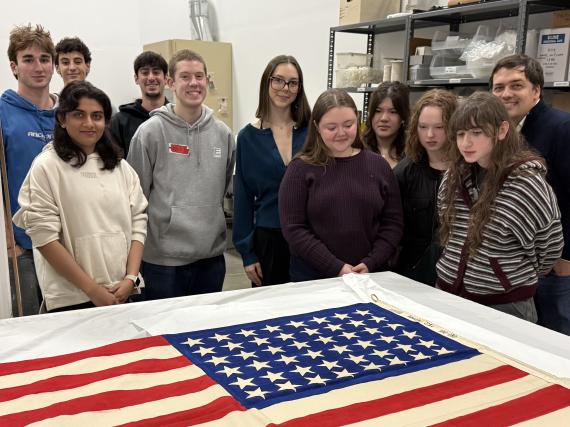
Kyle Haddad-Fonda with students looking at MOHAI collections
As these three stories show, history is never just a look back to the past, and UW History faculty accept the challenge of developing unique courses that interpret our past and provide context to help students understand our present time. From a class tracing the origins of our Western repressive norms on sexuality and gender to the Medieval times, to a course on Seattle's labor history, taught during a time when government agents are targeting migrant workers, to a course that teaches students how to analyze societal changes across the twentieth century through the medium of the Olympic Games, history faculty show innovation and creativity in connecting the past to the present.