Right now, it feels like teaching history is under attack from two sides: on the one hand there are the political elites who are pushing for a biased view of history and on the other hand, there are the technological advancements that are becoming a detriment to students' developing critical thinking skills. This sentiment dominated my recent conversation with UW History alumni who went on to teach high school history. These alumni, Debbie Galuska, Matthew Van Duyn, Kyle Bishop, and Kevin McKenna, talked to me about the importance of history education and the current challenges that teachers face in the age of AI. While their worry about the future of education was palpable, they also projected a sense of hope that their work is fundamental in helping their young students develop skills to navigate an increasingly complex world.
Debbie Galuska, a fourth-generation Washingtonian, came to the University of Washington knowing that she wanted to be a teacher. She graduated in 1973 with a B.A. in history, a minor in education, and her secondary teaching credentials. She entered the workforce at a time when teachers across the country were being cut due to plummeting student populations–only 35% of UW grads looking for teaching positions that year were successful. Debbie had to do a lot of substitute teaching before finally landing a permanent position. Now retired, she looks back on a long career of teaching and how it has changed. “In my high school days, it was a thick textbook–read the chapter, answer the questions at the end of each chapter.” In college, though, she was exposed to a world of in-depth reading and writing, a world where critical thinking skills were developed and writing skills honed. And she was exposed to ideas and beliefs she had never considered before. This inspired her to be creative in her own teaching, to broaden the curriculum and encourage her students to think outside the box and find what it was that truly excited them about history.
Throughout her career and now in retirement, Debbie actively promotes history education beyond the classroom. For example, she volunteers at regional History Day competitions organized throughout Washington State. History Day is a national, non-profit organization that strives to improve teaching and learning history in middle and high schools through regional competitions that engage students in year-long research projects, which are then evaluated by historians and educators. Debbie has also served on the UW History Advisory Board, and is its current chair. Advisory board members raise awareness of and promote UW History within the community and work to increase engagement with the department beyond the walls of the university. Through her advocacy, Debbie hopes to foster students' educational curiosity and to confront the challenges of our time. "I think the current moment is frightening and dangerous. History is under attack on so many levels. It is being rewritten, sanitized, erased, and mocked."
Our more recent alumni share Debbie's sentiment.
Matthew Van Duyn (PhD, 2020), decided to become a high school history teacher because he didn't want to leave Seattle for an academic job elsewhere. "Finding a partner, getting a dog, loving Seattle–all of that drew me toward a job that could keep me in the city and would allow me to keep thinking about history." Working at West Seattle High School with very large class sizes, Matthew embraces the challenge of serving all of his different students in face of district bureaucracy and budget cuts. He enjoys getting students without a prior interest in history to start thinking historically. "I’m a bit romantic in thinking that history helps us understand how the world came to be as it is, and I love getting students to make connections between what we are studying and the world they are experiencing." Reflecting on how the teaching of history changed from his own high school days, Matthew notes that teachers and teacher training have unsurprisingly moved away from an emphasis on note-taking and memorization. He explains that, perhaps more surprisingly, even reading and writing are sometimes de-emphasized in favor of activities perceived as "more engaging." He enjoys creative approaches such as role-playing and simulations, but he also describes himself as a defender of more traditional techniques. "As my confidence has grown over the past four years as a full-time teacher, I’ve gone back to lecturing more than I initially did and a lot of students seem to like it as well." Asked about the current challenges that teachers are facing Matthew enumerates: " AI, apathy, alienation, short attention spans, inability or unwillingness to read for sustained periods of time, and of course structural inequalities that shape our students' lives inside and outside of the classroom."
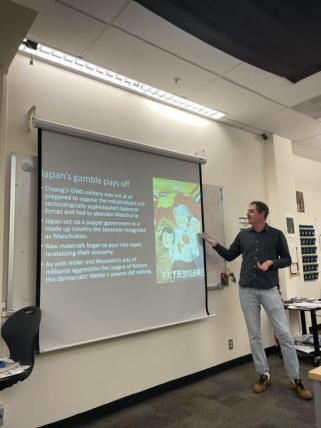
After receiving his B.A. in history and economics in 2020, Kyle Bishop went into the Master's in Teaching program, graduating with his teaching credentials in 2022. He and Matthew were in the same Master’s in Teaching cohort at UW. Since then, he has taught in private and public schools around Seattle. What he values most about private school teaching is the smaller class sizes, which make a big difference for his style of teaching. "I really lean on developing a positive relationship with students and building an engaging classroom culture, so that over time students feel like they can succeed and engage in discussion when otherwise they might stay quiet and listen." He agrees with Matthew that the methods of teaching history changed significantly from his own high school days. While his education revolved around memorizing dates and significant events, and studying great figures in history like presidents, in his teaching Kyle tries to involve the student voice quite a bit more. "What this looks like is socratic seminars, structured discussions, and projects rather than always using essays and exams." His time at UW was key in shaping his teaching style. "My professors were always prompting us to think about why events were historically significant. I also was inspired to dive deeper into understanding the experience of the everyday person, and stepping away from strictly focusing on great figures." He explains that his students get excited about his classes when they get the opportunity to dive into injustices that they did not learn about in earlier classes and start to ask more complex questions and wonder about connections to today’s world. "For example, teaching about Japanese American Incarceration, especially local Washington connections, is always a major area of interest to students. Further, learning about the redress movement shows students that there was a response to injustice."
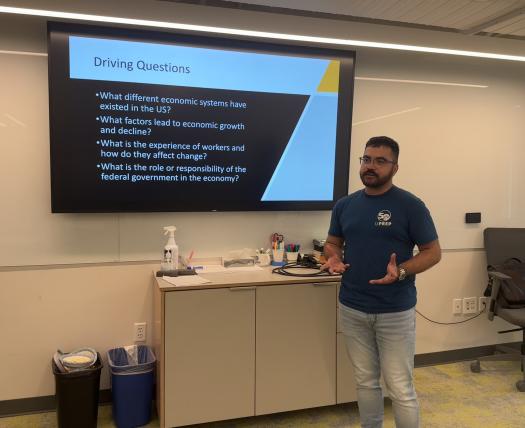
During their final year of the history PhD program in 2016-17, Kevin McKenna took an adjunct position at Lewis and Clark College, a private liberal arts college in Portland, Oregon. After that, they were hired at the Overlake School in Redmond, Washington. It was only when Kevin was looking to teach internationally that they pursued a teaching certification through Moreland University, an online program. Kevin has taught internationally at schools offering the International Baccalaureate diploma in places such as Dhaka, the capital of Bangladesh, as well as Lima, Peru. Teaching within different political and cultural contexts has made Kevin more tolerant of differing views and opinions and has let them see how these play out in the classroom. The political situation in Bangladesh also directly impacted their teaching. Kevin started teaching in Dhaka in 2023, a year before the July Revolution, a student-led protest movement, led to the resignation of the Prime Minister Sheikh Hasina, who had been in power for 16 years. "Prior to the July Revolution, I had to be careful about how I talked about Bangladesh’s government. I allowed students to share whatever perspectives they had to share, some of which were openly critical of the government, but I was not really free to share my own perspective until the government was overthrown." In Bangladesh, Kevin also had to be more careful about how to teach sensitive topics such as gender and sexuality. "For example, teaching a critical history of gender and sexuality in Bangladesh was not going to be possible, but I could engage students with relevant events happening in the country. In particular, there was an interesting intersection of anti-trans politics in a Western sense with hijra representation, an indigenous third gender in South Asia. And this allowed me to engage my students in conversations about gender identity that were otherwise difficult to bring up." Kevin explains that their graduate work with Amanda Lock Swarr, a professor of gender, women & sexuality studies, was key in equipping them to have conversations about hijra and trans identity with their students in Bangladesh. They add that their experience in the PhD program at UW fundamentally shaped their teaching style. "I try to better engage my students in the messy work of doing history. Wrestling with sources, drawing connections between the past and present, and developing thoughtful research questions that can guide deep inquiries."
My conversation with Matthew, Kyle, and Kevin naturally touched on the difficulties history teachers are facing today. Kevin sees two major challenges: the politicization of teaching history and the influence of AI. "Starting with the politicization of teaching history, you have to be careful about how you frame topics. I have found that students usually draw thoughtful conclusions when you give them the space to wrestle with sources, develop their own inquiries, research and draw their own conclusions." Kyle adds that teaching history in Seattle still feels safe in comparison to other states in the U.S. As a teacher at Shorewood High School, he developed the school's first AP African American Studies Course. "During this work I connected with other teachers of the course around the country, and constantly heard issues about their courses being blocked by their state or local school district, or general pushback. While I feel like teaching impactful history here in Seattle is pretty safe at the time, I am worried that someday that might change. I hope that our administrators, superintendents, and especially politicians will continue to support the work that history teachers do." Matthew agrees that they are fortunate to be teaching in Washington, where the state has not yet tried to dictate the history curriculum. "I aim to keep on teaching critical history focused on understanding power and oppression on the one hand, and how to fight back against those forces on the other."
Even before the usage of AI became widespread, teachers were shocked by the shortening of students' attention spans. Matthew jokingly suggests that his students' phone addictions turned him into a luddite. "There is nothing more depressing than seeing a room of 30 young people all staring at their phones during down time instead of talking to each other." Kevin agrees that it can be challenging to hold students' attention for an entire minute. "They were raised in such an overstimulated world of social media, and with parents who grew up in an entirely different pre-internet world."
They all agree that AI has just increased these tendencies. Kevin notes that many students have stopped thinking entirely. "They immediately take a question I’ve asked and plug it into ChatGPT before stopping for one second to even think about the question themselves, or even understand what question I am asking." As teachers, they approach these challenges differently depending on their teaching styles. Matthew regards AI as a parasite, which rarely serves the people it is marketed to and forced upon, perfectly designed to cheat on high school assignments. "My goal is to continue to teach students to read and write and embrace their humanity. Sometimes that just means more assignments with pencil and paper instead of computers." Kyle and Kevin share this sentiment and have also returned to using physical notebooks. At the same time, however, they do try incorporating AI into their classes to teach students how to use it properly.
For Kyle cheating is not the major concern in regard to AI, as plagiarism has always been an issue. He tries to impart upon his students the importance of studying history and learning how to think for themselves, but he does allow his students to use AI as a way to get them started. "For example, I require them to read and annotate a primary source first, but then allow them to run it through an AI program to translate key areas of confusion or difficult wording. By doing this, students still develop primary source analysis skills, and efficiently use AI to support their ideas without telling them what to think."
Kevin combines both teaching styles, requiring students to go with paper and pen for certain tasks while teaching them how to properly use technology for research. In unison with their fellow tenth grade co-teacher, they decided to go old school and require that students primarily use physical notebooks. Laptops are only used for research, project-based work, and the occasional online learning activity. "This is a recent shift we’ve made, but I am already seeing positive results. Students are generally more engaged. When they are on their laptops they are more likely to be engaging with the topic at hand. As part of our current Industrial Revolution unit, I look forward to having critical conversations with students about AI and its societal implications."
Despite the general sense of pessimism in regard to the current political moment, Kyle, Matthew, and Kevin perceive their work as high school history teachers as more important than ever. They experiment with different methods of teaching to grow along with the technological advancement, and they perceive their students as partners in learning how to handle the challenge of AI. Matthew argues that it is important to be honest with students and to not shy away from politics while also not preaching or telling students what to think. He is also a union rep and embraces labor organizing as a way to beat back the tides of austerity. Kevin explains how important it is to teach students critical media literacy. "In my Global Politics class especially, I start students off with a mini unit on media, including how algorithms shape what they see and don’t see. This helps them at the very least understand polarization if not see the ways in which their views are being algorithmically engineered." Kyle concludes that understanding history is one of our greatest assets in seeking positive change and opposing injustice in our world. All three UW History alums agree and are happy to be part of this work.