What if all the archival documents that a graduate student could ever hope to use for their dissertation research were available online? They would never have to leave Seattle. While this may seem appealing to some, so much of the experience and skills gained from research trips, such as networking with local experts, interacting with the geography of the places being studied, and finding hidden gems in unexpected places, would be lost. This year, two UW History graduate students have spent time away from Seattle for archival research and have shared with us their experiences, giving us a look at how their days are spent and what the experience has brought them.
Ari Forsyth spent winter quarter in New York conducting research at the Center for Jewish History (CJH) in downtown Manhattan, the world’s largest archive of the modern Jewish experience outside of Israel, for their dissertation, "Big Mother: A History of Jewish Social Work in the United States, 1880-1940," which focuses on the history of Jewish social work in three urban settings—New York, Chicago, and Seattle—and investigates how American Jewish relationships to race, gender, and (dis)ability were performed, policed, and transformed through everyday encounters between Jewish social workers and poor and working-class Jewish women and girls. Their research explores Jewish social work as a women-led labor and scientific movement but also a cultural field of Jewish identity formation in the United States and the wider Jewish diaspora. Ari argues that "the actions and self-understandings of ordinary Jewish women and girls, both social workers and their subjects, shaped modern social science and the welfare state from the bottom up."
For much of the early twentieth century, New York was a global hub for the Jewish diaspora and an important center of the American social work movement. Today, the records of Jewish social service agencies and professional training schools and personal papers of the movement’s leaders are housed at the CJH, where Ari spends each day digging through its archives. "While the CJH collections are my primary focus, I’ve also followed research leads across the city to other libraries and archives, like the New York Public Library."
Each day starts the same for Ari: a classic New York breakfast of a bagel with egg and cheese. Then, it's onto the 6 train downtown to spend their day at either the CJH in Union Square or the New York Public Library in Midtown. "I spend the day combing through archival documents, taking detailed notes and photographs to track my findings. I typically work from 9:30 a.m. until the archives close at 4:30 or 6:00 p.m. respectively. Thus, the big breakfast! Then I go home, make dinner, and spend a few hours doing 'archival admin work,' uploading my photographs and cleaning up my notes."
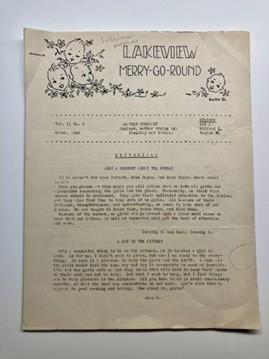
As most historians can tell you, there is a special moment when you come across an unexpected treasure in the archive that makes your heart beat faster. Ari has been fortunate enough to experience many such moments while in New York. One came after hours of looking through dry budget and correspondence files of the Jewish Federation of New York, an organization which funded several New York Jewish social service agencies like the Jewish Board of Guardians (JBG), a social agency that worked with other city organizations to rehabilitate Jewish juvenile delinquents. The JBG ran the Big Brother and Sister clubs, staffed social workers in municipal courts, and even operated reform schools and parole systems for Jewish delinquents. After initially struggling to find sources that depict the experiences of Jewish women and girls within these institutions, Ari discovered a document titled “The Lakeview Marry-Go-Round” inside a file from a Jewish adoption agency. To their delight, this document was a newsletter created by Jewish women and girl residents of JBG’s Lakeview Home for Unwed Mothers. It contained poetry, drawings, and stories by the very Jewish women and girls whose experiences Ari had been working to reconstruct. "This piece of ephemera, preserved by accident, captures the voices of a stigmatized class of Jewish women and girls who defied contemporary gendered norms. It reveals their individual personalities and perspectives on their situation, which are charming, prescient, and often quite funny!"
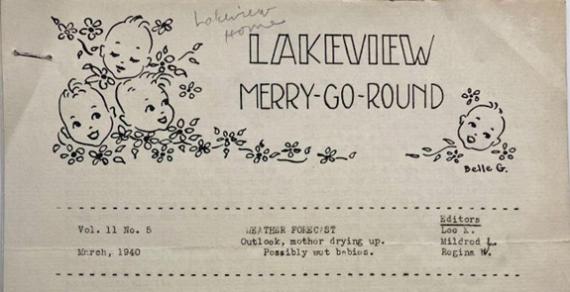
Header and illustration from The Lakeview Merry-Go-Round, March 1940, a publication by and for the Jewish “unwed mothers” at the Lakeview Home for Unwed Mothers in Staten Island. One of Ari’s archive highlights. Source: United Jewish Appeal collection, I-412. American Jewish Historical Society.
Ari's time in New York wasn't without challenges, though. January 2026 was the coldest month the city had seen in over a decade, and closures due to snow interfered a bit with Ari's research plans. On top of that, the elevator at the CJH was broken for over a month, which prevented access to important material within the American Jewish Historical Society collections. "I had to adapt on the fly." With help from the CJH’s reading room staff, Ari found ways to access some off-site collections at the New York Public Library. That research turned up some wonderful sources, including several master’s theses by students at the short-lived Graduate School for Jewish Social Work (1925-1940) in New York, which reflect the experience of rank-and-file workers and offer clues on the stories of disabled, gender-non-conforming, and criminalized Jewish women and girls in social welfare systems. "Still, my fingers are crossed that the elevator gets fixed soon!" says Ari, "Otherwise, I may have to find another way to return to the city, to access the key sources I need to write my dissertation."
Since returning to Seattle, Ari has been busy working as a graduate teaching assistant (TA) and writing the first chapter of their dissertation. Despite having just returned, Ari is already planning another research trip, this time to Chicago. "It is such a privilege to get to travel to conduct critical research for my dissertation, but I miss my loved ones, friends, colleagues, and mentors. I miss the beautiful green parks and the people in Seattle. Most of all, I miss the community—the everyday opportunities to give and receive support, to build intimacy and resilience together—the kinds of resources that come from growing roots in a city that you call home."
UPDATE: Not only has the elevator been fixed, but Ari has been awarded the 2026-27 Arcadia Graduate Fellowship at the CJH, which means they will be returning to New York next year to continue their research on the history of Jewish social work in the United States. Congratulations, Ari!
For Sue Zhou, a typical research day begins at 7:30 a.m. when, in an attempt to avoid being crammed like a sardine in the overcrowded Beijing metro, she cycles to the First Historical Archives of China in central Beijing, the primary repository for Qing-era (1644-1911) sources. Established as the imperial archive in 1534 and originally housed within the Forbidden City (the imperial palace complex), the institution relocated to its new, modern research facility near the Temple of Heaven in 2022. Having spent the last year in China, Sue has not only become an expert at navigating the overwhelming traffic in Beijing but also in deciphering legal documents from the eighteenth-century Qing dynasty.
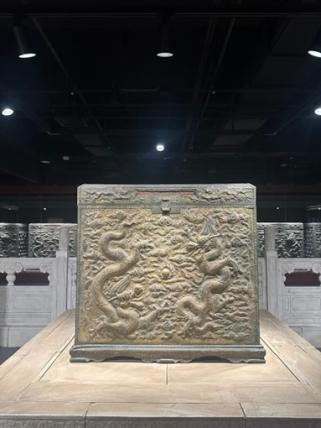
The “dragon cabinet”, a special container for the imperial archives from the Qing dynasty.
Sue's dissertation, "The Affective Rebellions: Karst Borderlands and Environmental Governmentality in the Wuling Mountain Region of Southwest China, 1723–1796," explores the environmental and affective experiences of people living in Southwest China, a peripheral region of the empire known for its distinctive karst topography. By looking at deposition records, Sue examines rebellions and everyday politics in the eighteenth-century Qing dynasty. "These materials detail the causes, processes, and interpersonal dynamics of conflict, and they are especially valuable for accessing the voices of ordinary people, even though those voices were often shaped by judicial coercion and procedural constraints." She explains that most scholars have focused on major rebellions such as the White Lotus Rebellion (1794-1804) and the Taiping Rebellion (1850-1864). In contrast, her work has been devoted to the smaller-scale rebellions and everyday forms of resistance that preceded them in the eighteenth century. "I argue that rebellion is always charged with affect and emotion, dimensions that cannot be fully understood through economic or structural analysis alone. Deposition records, despite their limitations, are crucial sources for decoding these emotional and experiential layers." By situating uprisings in the Qing empire within a wider global history of revolutions and revolts, Sue's study offers a broader comparative discussion of the Age of Revolution, a period marked by political upheavals across Eurasia and the Americas.
Going through thousands of capital case records stored at the archive, Sue has found plenty of sources that reveal the social reality of ordinary people who instigated uprisings. For example, one facet of her work focuses on the technology of indigo dyeing. It is normally a struggle for historians to reconstruct the small details of everyday life among common people, such as the color of their clothing, because these mundane aspects are deemed irrelevant by chroniclers of history. However, found within lists of stolen items in robbery cases, Sue discovered descriptions of clothing. "I realized the clothing items were all in blue." Sue explains that the different shades of blue from darker to lighter signify a hierarchy: the darker the blue the more difficult it is to dye, so dark blue colored clothes were reserved for important occasions or to show off one's wealth. "For me, it reveals an entire world of aesthetic sensibilities that people were exposed to in their everyday lives—deeply significant, yet often difficult to incorporate into conventional historical narratives, and nevertheless crucial for historians to remain attentive to."
Sue is the recipient of one of UW History’s digital history fellowships, which has allowed her to conduct a side-project while in Beijing that examines the regulation of firearms during the eighteenth century Qing dynasty. In reading hundreds of cases concerning offenses involving the private holding of firearms, especially bird guns, Sue realized that there was a lack of consistency in what was considered a “bird gun.” "Many cases involved the manufacturing and usage of zhuchong (bamboo guns), and the local magistrates or judicial authorities were really inconsistent on whether these counted as firearms or not." By analyzing these legal cases pertaining to the everyday life of ordinary people, Sue added a crucial component toward understanding China’s eighteenth-century popular uprisings.
After several hours of reading deposition records and legal documents, Sue takes a lunch break at one of the restaurants near the archives and grabs an iced latte. "There are hundreds of restaurants within a ten-minute walk of the archives, and the most iconic shop nearby is a bakery that is dubbed the best Napoleon cake in Beijing, which I occasionally visit." She then returns to her research and stays until closing at 4:30 p.m., at which point, to clear her head, she goes for a run in a park on her way home.
One day, Sue discovered an interesting connection between her research and her daily run when she came across a court case involving an enslaved woman named Ruchun. Ruchun was the daughter of a rebel leader who, as punishment for her father’s activities, had been forced into slavery when she was just five-years-old. Years later, after refusing to clean a bird cage, she fled, which was a capital offense. The surprising connection that Sue made between this case and her daily run was that the park where Sue runs is the area where Ruchan herself lived. Now a part of Beijing’s urban core, it was once on the outskirts of the city and home to the service quarter that housed some of the most exploited laborers of the empire. In the end, the court did not impose the death penalty on Ruchun and criticized her master’s cruel conduct, but despite that, she was not emancipated. "Ever since reading the case, my conceptualization of my daily commute has transformed. I always remember Ruchun’s experience when I go to the park. Sometimes, when I make my own commute to the archives in the morning and see others heading to their offices along the same route, I feel as though we are re-enacting yet remaining oblivious to the past."
After a year of intense archival research, Sue is excited to return to Seattle and once again be in the same time zone as her friends and colleagues. She missed seeing Mount Rainier, UW’s beautiful campus, and also having more time to write.
Traveling to conduct archival research enriches the experience of UW History graduate students. From finding hidden gems, to interacting with local culture, befriending archivists, and exploring and navigating cities, research trips allow students to interact and engage with their subject matter in ways that cannot be replicated in the classroom. And when they return to Seattle to start writing their dissertations, they not only have suitcases full of sources but also experiences and memories that will last a lifetime.