Kyle Haddad-Fonda, a lecturer within the Department of History, is teaching a new course he developed, the Modern Olympics Games. We caught up with Kyle to talk about this course and what inspired him to create it.
You are a historian of modern China and the Middle East, and in the past you have taught courses about the Cold War and about modern North Africa. How did you come up with the idea to teach a course on the modern Olympics? Are you a sports fan?
I certainly have fond memories of watching the Olympics as a kid. When I was in first grade, I drew all the flags of the countries that were competing in Lillehammer. In 1996, when my grandfather was recovering from a broken hip and my parents were busy helping him move out of his house with too many stairs, my mom sat him and me on the couch and instructed each of us separately that our job was to babysit the other. We then proceeded to watch all of the Atlanta Olympics. But I had no academic interest in sports history until recently.
What happened was that I started to realize that inserting anecdotes about sports into my lectures about the Cold War caused students to perk up and pay attention. I came to think of sports as a gateway into all manner of bigger and broader themes.
One thing that I mentioned in my Cold War course was that the Catholic Church promoted soccer in Italy in the immediate aftermath of World War II, and that that effort fit into a broader campaign to combat communist influence. I probably spent less than a minute of my lecture on this topic, but one of my students, a history major named Moniva Pal, really latched onto it and started to read more articles about soccer in Italy. A year later, Moniva came to me and said that this discussion had opened her eyes to the fact that sports history could be a meaningful field. I went on to advise her senior thesis about defections by athletes from communist countries in the short period between the fall of the Berlin Wall and the collapse of the Soviet Union. Moniva’s very enthusiastic reaction to the sports content in my Cold War course and our many conversations about her senior thesis on a sports-related topic helped give me the final push I needed to move forward with creating a new course about sports history. I knew that the 2026 Winter Olympics were coming up, and I thought, “Okay, I’ve been mulling this over for a long time; now it’s finally time to make it happen.”
What was the process of creating the syllabus for this class like?
From the start, I was aware that I would never be able to talk about everything. There have been 54 iterations of the Olympic Games—and by the end of this month, there will have been 55. There’s no point in trying to go games by games, making sure to say something about each of them. Instead, the approach has to be thematic. To put the syllabus together, I had to make a list of the themes I wanted to highlight, then figure out which moments in Olympic history would allow me to dive into those themes. I see my course as a kind of sampler platter of all the main topics of twentieth-century history, and I’m hopeful that some of my students will want to explore particular topics further in other history department courses.
What kinds of primary sources are you assigning? Do you have a favorite one that you are most excited to share with your students?
Every time I teach, I try to highlight a wide variety of different types of primary sources. Part of my job is to teach students how to think like a historian, and that means dealing with original materials. This quarter, we’re engaging with government documents, memoirs, newspaper articles, film, fiction, political cartoons, and more. We’re even going to watch two episodes from an Australian sitcom about the preparations for the 2000 Summer Olympics in Sydney.
One of the sources I was most excited to share with my students was a compilation I assembled of newspaper articles about Eleanor Holm. In 1932, at nineteen years old, Holm won a gold medal in the backstroke in Los Angeles, where the media deemed her the prettiest girl at the Olympics. Over the next four years, Holm dabbled in Hollywood and fended off challenges about her amateur status. But on the ship to Berlin, where she was poised to defend her Olympic title, she was kicked off the U.S. team for having had the audacity to stay up late drinking champagne. Her scandal raised a lot of questions about the nature of celebrity, the power of the media, and the enforcement of amateurism that my students could discuss in the classroom. I was particularly grateful to the UW’s history librarian, Aubrey Williams, for helping me track down several articles from African-American newspapers about the dismissal of Holm (who was white); those articles speculated about how Black athletes on the U.S. team would have been treated if they had found themselves in the same position, in ways that triggered a really vibrant discussion in the classroom.
Who are your students this quarter? Are they mainly history majors or are there students from other departments as well? What are their motivations for signing up for this class? Do you think they mainly signed up because they are interested in sports?
Only four of my 58 students are current or aspiring history majors. The vast majority of my students are in their first year at UW. Certainly, a lot of them are sports fans. One told me at the beginning of the quarter, “I figured I could act like my watching the Olympics constantly for two weeks could count as homework.” But mostly, I get the sense that a lot of my students wanted to fulfill distribution requirements while learning some history from a perspective that is very different from how they were taught history in high school.
As part of your class, you took students on an optional field trip to the Museum of History and Industry (MOHAI) Resource Center. How was the field trip? Was there a specific artifact that raised their curiosity the most?
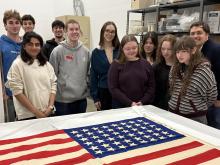
We had a wonderful time. With support from the history department’s donor supported funds, I was able to take ten of my students on a Friday morning down to Georgetown to learn about how museum professionals conserve artifacts and use them to teach the public about history. I was especially grateful to MOHAI’s Clara Berg, who invited me to bring my students and shared her many years of expertise with them. The headliners were MOHAI’s collections from two local athletes, Helene Madison, who won three gold medals in swimming in 1932, and Joe Rantz, one of the eponymous “boys in the boat” who won gold in rowing in 1936. We also saw a collection of materials from the 1990 Goodwill Games, along with a smattering of other things. But the most important part of the visit was just the opportunity for my students to ask questions of Clara and her colleagues, who obliged them with story after story about the challenges they had faced in preserving pieces of the past.
I think the most dramatic single item that we saw from MOHAI’s collection was a woman’s swimsuit from 1906. I had talked extensively in class about the evolution of women’s swimwear and about the social changes that resulted in more and more girls being taught how to swim. And I had talked about the female U.S. swimmers at the 1920 Olympics, who refused to wear the clunky “modest” swimsuits brought for them by the team’s male organizers and instead swept the medals in their own practice suits. But absolutely no photo that I could have put on a PowerPoint slide in class could ever show just how much fabric was on a standard woman’s swimsuit in the early 1900s. It’s something you have to see in person!
How much do the 2026 Winter Olympics taking place right now in Italy figure into your course?
You and I are having this conversation on the day of the 2026 opening ceremonies. All week, people have been asking me whether I’m going to teach about the current Winter Olympics in my history course. The short answer is no; I can’t very well prepare to teach from a historical perspective about something that hasn’t happened yet. But it’s very important to me that my students will be able to watch the current Olympics and feel like my course has prepared them to think critically about what is happening.
At the beginning of the quarter, I told my students that one of the questions on the final exam would be, “Describe any one specific aspect of the 2026 Winter Olympics that you understood better because of what you learned in this course.” Of course, nobody can answer that question yet, but I’m confident that there will soon be dozens upon dozens of possible answers to it.
If there was only one thing that your students should take away from your course, what would that be?
It’s always striking, in watching coverage of the Olympics on American television, how ill-informed the commentary is about the history of the games. It’s especially noticeable that the broadcasters seem determined to avoid mentioning anything that might be perceived as “messy”—even though the reality is that every aspect of the Olympics has always been messy. I was just complaining yesterday in class about the broadcast of a men’s water polo match in 2024 between the U.S. and South Africa. One of the commentators pointed out that South Africa had competed in Olympic water polo in 1952 and 1960, but then hadn’t played water polo in the Olympics between 1960 and 2024. And that was it—the end of the discussion. I remember screaming at my television, “And are you going to tell people why not?” It’s not like people in South Africa suddenly forgot how to swim. What happened was that, after the 1960 Summer Olympics, the entire country was banned from the Olympic movement because the country’s brutal and systematic racial discrimination in the field of sports was a violation of the Olympic Charter. The expulsion of South Africa was the result of tireless campaigning by a transnational network of dedicated activists, and the international sports boycotts were an important component of the movement to end apartheid. That part of the story needs to be front and center, not obfuscated by commentary that assumes that the messiness of history is irrelevant to the game at hand.
I tell this story to emphasize that I want my students to know that historical forces are always present, lurking just below the surface—but that they’re going to have to do some legwork to dig them up. That’s true of everything in our society, not just the Olympics. One thing that college history courses can do for students, regardless of their major, is to prepare them to go search for the story behind the story. I want students to refuse to be satisfied with what they’re told, but instead to have the tools to look a little deeper in the hope of understanding how things got to be the way they are.