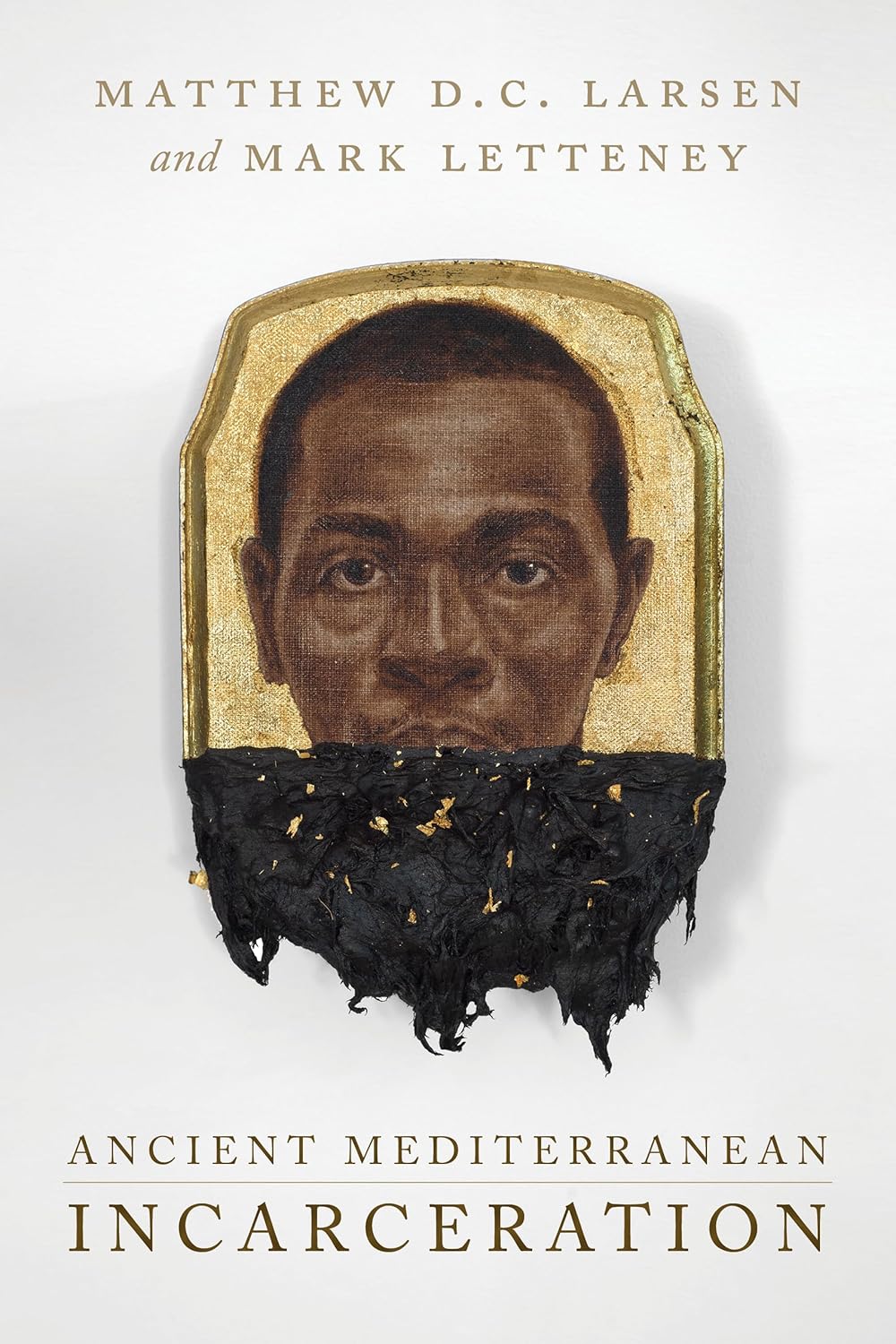
UW History graduate student Joana Bürger recently sat down for a conversation with Mark Letteney, archeologist and professor of ancient history affiliated with the history department, the Stroum Center for Jewish Studies, and the comparative religion program, to talk about the publication of his latest book Ancient Mediterranean Incarceration that was released by University of California Press in August 2025.
JB: Congratulations on the publication of your latest book! It was coauthored with Professor Matthew Larsen, of the University of Copenhagen. How did the two of you meet and how did you come up with the idea for this book? In the preface, you say that it includes data collected over the course of nine years. Are you relieved that it is finally out there now?
ML: Yes, Matthew and I are thrilled that the book has finally appeared, and that it has already made it to a much wider readership than we expected!
We met in a graduate seminar during the fall of 2012, and quickly became close friends and intellectual confidants, bouncing ideas off one-another as we each completed our PhDs and wrote our first books.
A couple years later, we took a trip to Algeria to test out an idea: we speculated that some spaces which archaeologists had understood as treasuries were, in fact, prisons. The book writing process began in the wake of that trip, when it became clear that the articles we had written and planned would not be sufficient to tackle the broader question of how the prison was used in the ancient Mediterranean and, importantly, how prisons were experienced by their victims.
JB: Your book studies systems of incarceration in the ancient Mediterranean world and you oppose the idea held by many today, and popularized by Michel Foucault, that prison systems are a modern invention. Can you summarize the main argument for us? Give us your book in a nutshell?
ML: The details are complex, and I would encourage interested readers to check out the book’s first chapter, which lays out the stakes, the data, and the intervention that we hope to make. The basic story, however, is this: there has been a persistent myth in the field of ancient history and carceral studies that the prison—a place built and sanctioned by state authorities for the purpose of punishing deviance—is an invention of the early modern period. We think that this premise is false.
For instance, ancient Roman lawyers regularly proposed incarceration as a form of punishment—representatives of the state routinely enforced the punishment of imprisonment and released prisoners after they had served their time. And perhaps most importantly, prisoners experienced their incarceration as a form of punishment. The main historical argument of the book is that the prison does not have a history of two centuries but at least two millennia, and further that it probably is not the kind of institution that has a clear birth to mark or a single origin story to uncover.
However, the main methodological argument is just as important: we must counterbalance the ideals of incarcerators by prioritizing the voices of captives. Prisoners understand the system that binds them, and we ought to listen when they tell us what that system is like because those experiences are just as valid sources of historical knowledge as the ideals and scruples of their captors.
JB: Usually, scholars are used to working on their research alone and writing is often described as a solitary activity. How was the process of co-writing this book for you? What was the division of labor between you and Matthew? Did you divide up the chapters? Did you ever run into difficulties or disagreements?
ML: In graduate school, a mentor of mine had a cross-stitch in his office that read “frequent collaborator.” I’ve always wanted to follow in those footsteps, and I try my best to do so. The reason is this: in most instances, co-authored work is better, and how could it not be? My work is enriched by collaboration, and new ideas and modes of analysis come out of the alchemy of academic partnership that neither party would have created on their own.
Matthew and I began by thinking about archaeological and literary materials, and in March 2020 when he was on lockdown in Princeton, and I in Athens, we began a new tradition that continued for the next four years: two- to three-hour Zoom sessions a few times a week. At first, we used the time to translate papyri, and eventually, we started writing together on Zoom. During the most intensive parts of writing the book we would first meet to hammer out the core argument of each section and sketch out the data we’d implement to support it. Afterwards, one of us would write a first draft. When we both had a section drafted, we would switch: editing, expanding, and simplifying the other’s work. This process entailed a lot of sentence-by-sentence reading and editing live on Google Docs. In the end, each section has been recomposed so many times that neither Matthew nor I could tell you who wrote what. (With a few choice phrases excepted: Matthew wrote the last four sentences. I will forever wish I had come up with such an elegant conclusion. On the other hand, many of the puns are my fault.)
Disagreements were common—sometimes over a translation or an interpretation, and sometimes over phrasing or aims. We did what one must do in an academic collaboration: we compromised, recognizing when we needed to stand our ground, and when we could let go and move on, trusting the other’s judgement. Trust really is key for work like this, as is its corollary: a level of intellectual humility and openness to the idea and correction of others.
JB: You state in your book that you visited sites of ancient incarceration to look at their remains and that you collected documentary evidence such as letters, tax receipts, orders for arrest etc. In other words, you used archeological and documentary evidence instead of focusing primarily on literary sources as many of your predecessors have done. Do you have a specific source that sticks out? What surprised you the most? You also state that you tried to unearth the voices of incarcerated people. How did you achieve this? What sources did you use for that?
ML: I remember distinctly one Zoom session rather early in the writing process, where Matthew and I were reading and translating a papyrus (BGU 16.2618, D146 in the online database), in which a woman named Tryphas, living in Roman Egypt of 7 BCE, wrote to her son to remind him “to care for the slaves.” If he didn’t, she wrote, “they will die in the prison.” In this case a wealthy landowner owed a debt, and instead of paying what she owed, she lodged people she had enslaved in the local prison as collateral while she waited for grain prices to rise, so she could pay off her debt on the cheap.
These enslaved people waited in the meantime, their very lives in danger because Tryphas’s son repeatedly forgot to go to the prison to bring them food. In the moment that this situation crystallized for me I had to take a break, because the inhumanity that this papyrus represented was overwhelming. But it also caused Matthew and I to think more closely about the ancient prison as a tool of the wealthy whose functions were broader even than we had anticipated.
Wherever we can, we try to listen to the voices of incarcerated people. The closest we can get is through their graffiti, like one from the prison of Corinth in Late Antiquity, where a prisoner wrote on the floor “May the fortune of those who suffer in this lawless place prevail. Lord, do not show mercy on the one who threw us in here.” (IG 4(2).3.1277, Database D243)
We also unearth the experiences of prisoners by reading petitions that they wrote. For example, I have been working recently with letters that prisoners wrote to a local powerbroker in the Egyptian Fayuum oasis during the third century BCE. Over the course of his public life, he received about sixty such letters by prisoners asking for similar things: release, sustenance, trial, or mercy. By paying close attention to the requests we can understand something of the constraints that these people were under, and something about the nature of the system itself, including what prisoners believed a powerful man could do to manipulate it.
JB: Your insights on ancient carceral practices sounds very relevant to our current times. What did you learn from your research about today's systems of state punishment? If I am not mistaken, your co-author Matthew Larsen is based in Denmark, and Denmark's prison system, focusing on reeducation and with minimal security, is very different from that in the United States. Did that figure into your work? What are some take-aways from your research and cooperation with Matthew Larsen on how things should change in the United States?
ML: At the end of the day, my personal vision for the future of the prison isn’t much different from that of Angela Davis: they must be abolished. As we write in the book, “In broad strokes, this system has been in place for over two thousand years at least. Perhaps a system that has been ‘broken’ since antiquity is, in fact, functioning as designed, even if that design is veiled, misnamed, or unintentional.” (91)
However, I am not a criminologist or a lawyer: I do not endeavor to give policy proposals, nor does the book. Matthew and I hope that this information can inform people thinking about the relationship between the prison’s past and a possible, more just future, and we think that this evidence can be used as a mirror, showing us what aspects of the current carceral system are truly novel and which are bound up in longer histories. I do think that we need to move past the far-too-easy premise that the prison is an invention of modernity, and its corollary: that if we can fix the problems of modernity, we can fix the problem of the prison. How that happens I believe must be a collaborative endeavor, with experts and activists working hand-in-hand. I hope that this book can spur more collaboration and creative, historically informed thinking about where we might go from here as a society.